Believing in ESP is almost like believing in a certain religion. While there are many experiments that fail to show it exists, a few, a very few seem to point to it being a real power... a sixth sense. Unfortunately, most of the tests that have shown ESP to be an effective force were questionably designed or simply stage shows that mystified the crowd, scientists included.
A very religious man once told me that he believed that things like witchcraft and demons simply proved that one side of the spiritual equation existed. He could then, by inference, believe in the other side... God, angels and Heaven. It was a working argument for him. Alas, I've never seen an experiment that showed ESP or any spiritual belief is demonstrable. That doesn't matter to me. I believe what I believe. That kind of belief requires no proof or duplicatable experiment. It is a gut feeling that doesn't have to be justified.
All this is leading up to what almost convinced a very hard nosed psychologist that ESP was a working force. During my senior year in university, I took a course in experimental psychology. It was fascinating. The experimental designs and statistics used to interpret the results were rigorous and could actually be duplicated with similar equipment and environment.
We were assigned the task of designing and implementing an experiment that would either show that ExtraSensory Perception existed or not. Of course, it was a given that the negative hypothesis in this case would not prove ESP's non-existence. "Absence of proof is not proof of absence." I don't remember who said that, but it applies.
We were given access to state of the art, electro-mechanical test equipment and used it to see if a subject, chosen at random from the student body could predict which of five symbols was going to appear on the screen in front of him. Results were tallied on the experimenter's control board. I was running a subject through the test and didn't notice Dr. Gardner entering the lab. The first I knew of his presence was when he asked, "How long have you been doing that?"
He had been watching me and I was recording the results without looking at the tally board. Dr. Gardner was just a little spooked. While none of our results indicated that any of our subjects could forecast what would appear, it looked like I was doing just that with the results.
Calm down. Remember that we were using electro-mechanical equipment, not digital. Each of the symbols' tally used a different electric motor and gear mechanism. My hearing was still good enough that I could detect the differences between them. That hearing is about gone now, thanks to the Army, but the memory of Dr. Gardner's face remains.
Sorry, no pictures for this memoir.
Friday, November 21, 2008


Sunday, November 2, 2008
Three book reviews
Some time ago, I noted a few of the authors that I particularly like and recommend. I have just finished the books whose reviews I will write this evening.
"The Accidental Time Machine" by Joe Haldeman, Ace Books edition published August, 2008. ISBN 978-0-441-01616-7
paper back $7.99
Matthew (Matt) Nagle did not set out to invent a time machine. He was working on a calibrator. When he pushed the 'reset' button, the thing disappeared for a second. When he pushed it again, it disappeared again, for a little longer this time. Matt is a bright, young PhD candidate at MIT. It doesn't take him long to work out that he has a time machine and that each time he pushes the button, the machine goes farther into the future. After all, Einstein worked out that you can't go backwards in time.
Matt works out how to go along with the machine, then proceeds to head farther into the future. His first trip takes him just far enough that he discovers that his vehicle (borrowed from a friend) is in the middle of traffic and has no tires. He also discovers that his friend has been murdered. Matt is the prime suspect, but the authorities lock him up for auto theft. A strange person who looks like Matt pays his bail and tells him to take the car and go. He pushes the button again and goes farther ahead in time. Soon he picks up a companion, Martha. She is from a time when radical Christianity dominates the east coast of America and has nothing to do with the west. Each time Matt pushes the button, he not only goes into the future, but moves west as well.
The problem is how to get back to bail himself out of jail and whether Martha will go with him or return to her own time and place. The situation is made more interesting when he discovers that he is the only one who can push the button and get a time displacement.
Haldeman is an outstanding writer. This novel caught me within a few paragraphs and held me through the end. The physics are all too plausible. We have a good adventure story with a little romance, a lot of mystery and some humor.
"The Bell at Sealey Head" by Patricia A. McKillip, Berkley Publishing Group, published September, 2008. ISBN 978-0-441-01630-3, hard cover $23.95.
In the coastal town of Sealey Head, a bell rings at every sunset. No one knows why. Nor does anyone know where the bell is located. The bell has been ringing for so long that most town folk don't notice it anymore. Judd Cauley still notices. He runs an inn at Sealey Head, just as his father did. Dugold, his father is now blind. Judd reads to him every night. Another person who notices the bell is Gwyneth Blair. She and Judd have been friends since childhood. But her family is rich and the inn, both poor and declining. Their meetings are infrequent, but welcomed by both.
On the day the story begins, a stranger comes to Sealey Head and stops at the inn. He is Ridley Dow and he has come to investigate the bell.
Emma is a maid at Aislin House. Since she was small, she has been opening doors that do not always lead to her Aislin House. She has met Princess Ysabo, a resident of the other house. Ysabo is caught in a mysterious ritual that enfolds all the residents of her house. She is shortly to be married and is well trained in the ritual that keeps their world turning.
The owner of Emma's Aislin House, Lady Eglantyne, is old, ill and declining. The heir is sent for from the big city of Landringham. Miranda Beryl will soon arrive with her staff and friends for the death watch. Among the friends is a Mr. Moren. Apparently Beryl is afraid of him. At the same time as the guests arrive, Judd is lucky enough to hire a new cook. (His old one is possibly the worst cook in the world.) Mr. Pilchard, the cook says that he has been a sailor and can cook for two or two hundred. His cooking is superb.
Ridley makes his way to Aislin House and meets Beryl. He also meets Emma and, through her, Ysabo. Ridley does something that neither woman has dared. He crosses from Emma's world to that of Ysabo. Ridley has the talent for being inconspicuous to the point of invisibility. He stays in Ysabo's world for a few days, then is chased away by the ritual crows and the knights of the House.
Ms. McKillip writes in a fascinating, dreamy style that has always appealed to me. Her way of conveying mystery and magic are irresistible. The complex story lines of her novel are expertly woven together to produce a startling, but altogether satisfying ending.
"Carol for Another Christmas" by Elizabeth Ann Scarborough, Ace Books, published October, 2008 (first publishing 1996). ISBN 978-0-441-01646-4, paper back $7.99.
This is a retelling of Charles Dickens' "A Christmas Carol". What Ms. Scarborough has done is to bring the story into the 21st century, replacing Scrooge with an irascible software company CEO (Monika Banks) and Marley with her brother, one of the geniuses who began the company. The company is failing. Banks has hired a team of software specialists to develop a program for the US government that will track people without their knowing.
The ghost of her brother works a program manager into the computer system. Scrooge, now converted to a Christmas spirit gets the job of guiding Banks around her Christmases past, present and future with the desired result.
This is not the first time that Ms Scarborough has updated a fairy tale. Her "Godmother" was a wonderful look into the business of being a fairy godmother. Her style is engaging and the story has all the tender, tear jerking pathos of the original. This is definitely a six Kleenex novel. She has managed to insert believable technology, humor and a bit of romance into the original. This book is going out to most of my friends who like to read... as a Christmas present.
"The Accidental Time Machine" by Joe Haldeman, Ace Books edition published August, 2008. ISBN 978-0-441-01616-7
paper back $7.99
Matthew (Matt) Nagle did not set out to invent a time machine. He was working on a calibrator. When he pushed the 'reset' button, the thing disappeared for a second. When he pushed it again, it disappeared again, for a little longer this time. Matt is a bright, young PhD candidate at MIT. It doesn't take him long to work out that he has a time machine and that each time he pushes the button, the machine goes farther into the future. After all, Einstein worked out that you can't go backwards in time.
Matt works out how to go along with the machine, then proceeds to head farther into the future. His first trip takes him just far enough that he discovers that his vehicle (borrowed from a friend) is in the middle of traffic and has no tires. He also discovers that his friend has been murdered. Matt is the prime suspect, but the authorities lock him up for auto theft. A strange person who looks like Matt pays his bail and tells him to take the car and go. He pushes the button again and goes farther ahead in time. Soon he picks up a companion, Martha. She is from a time when radical Christianity dominates the east coast of America and has nothing to do with the west. Each time Matt pushes the button, he not only goes into the future, but moves west as well.
The problem is how to get back to bail himself out of jail and whether Martha will go with him or return to her own time and place. The situation is made more interesting when he discovers that he is the only one who can push the button and get a time displacement.
Haldeman is an outstanding writer. This novel caught me within a few paragraphs and held me through the end. The physics are all too plausible. We have a good adventure story with a little romance, a lot of mystery and some humor.
"The Bell at Sealey Head" by Patricia A. McKillip, Berkley Publishing Group, published September, 2008. ISBN 978-0-441-01630-3, hard cover $23.95.
In the coastal town of Sealey Head, a bell rings at every sunset. No one knows why. Nor does anyone know where the bell is located. The bell has been ringing for so long that most town folk don't notice it anymore. Judd Cauley still notices. He runs an inn at Sealey Head, just as his father did. Dugold, his father is now blind. Judd reads to him every night. Another person who notices the bell is Gwyneth Blair. She and Judd have been friends since childhood. But her family is rich and the inn, both poor and declining. Their meetings are infrequent, but welcomed by both.
On the day the story begins, a stranger comes to Sealey Head and stops at the inn. He is Ridley Dow and he has come to investigate the bell.
Emma is a maid at Aislin House. Since she was small, she has been opening doors that do not always lead to her Aislin House. She has met Princess Ysabo, a resident of the other house. Ysabo is caught in a mysterious ritual that enfolds all the residents of her house. She is shortly to be married and is well trained in the ritual that keeps their world turning.
The owner of Emma's Aislin House, Lady Eglantyne, is old, ill and declining. The heir is sent for from the big city of Landringham. Miranda Beryl will soon arrive with her staff and friends for the death watch. Among the friends is a Mr. Moren. Apparently Beryl is afraid of him. At the same time as the guests arrive, Judd is lucky enough to hire a new cook. (His old one is possibly the worst cook in the world.) Mr. Pilchard, the cook says that he has been a sailor and can cook for two or two hundred. His cooking is superb.
Ridley makes his way to Aislin House and meets Beryl. He also meets Emma and, through her, Ysabo. Ridley does something that neither woman has dared. He crosses from Emma's world to that of Ysabo. Ridley has the talent for being inconspicuous to the point of invisibility. He stays in Ysabo's world for a few days, then is chased away by the ritual crows and the knights of the House.
Ms. McKillip writes in a fascinating, dreamy style that has always appealed to me. Her way of conveying mystery and magic are irresistible. The complex story lines of her novel are expertly woven together to produce a startling, but altogether satisfying ending.
"Carol for Another Christmas" by Elizabeth Ann Scarborough, Ace Books, published October, 2008 (first publishing 1996). ISBN 978-0-441-01646-4, paper back $7.99.
This is a retelling of Charles Dickens' "A Christmas Carol". What Ms. Scarborough has done is to bring the story into the 21st century, replacing Scrooge with an irascible software company CEO (Monika Banks) and Marley with her brother, one of the geniuses who began the company. The company is failing. Banks has hired a team of software specialists to develop a program for the US government that will track people without their knowing.
The ghost of her brother works a program manager into the computer system. Scrooge, now converted to a Christmas spirit gets the job of guiding Banks around her Christmases past, present and future with the desired result.
This is not the first time that Ms Scarborough has updated a fairy tale. Her "Godmother" was a wonderful look into the business of being a fairy godmother. Her style is engaging and the story has all the tender, tear jerking pathos of the original. This is definitely a six Kleenex novel. She has managed to insert believable technology, humor and a bit of romance into the original. This book is going out to most of my friends who like to read... as a Christmas present.
Thursday, October 30, 2008
Tiger Toy


That's my nickname. I'm attaching some pictures so my new writing group can see them.
The kitties are Siberian tigers (also known as Amur tigers). They're the biggest of the natural cat family still in existence today. There are a couple of "ligers" that are considerably larger. But ligers do not occur naturally since the ranges of lions and tigers are pretty well separated... even in India, which has a lion area in its far west.
Wednesday, October 29, 2008
A few comments
Fall is a terrific season for the garden. Those dead leaves make great mulch to protect plants from lower temperatures in the winter. But another neat thing is that many of the annuals begin to go to seed. So now is a good time to begin harvesting. I have been getting seeds from the purple cone flower

and the Indian blanket flower. Both are shown here.

Of course there is the delightful changing of the leaves. They turn glorious colors as the sap leaves them to dry and to fall. The Japanese maple shown here is pretty red most of the year. But it gives an idea. The hard woods, such as maples are the most colorful. But birches, aspens, and Bradford pear also put on a fine show.

This afternoon, my wife and I were having lunch in a Mexican restaurant. There were a couple of people who sat and talked on their cell phones while feeding their faces. That's slightly rude. Ruder still was the fact that they were having lunch with other people. I fear that if one of my friends were to do that, they would get some pretty stiff words on the subject. Fortunately, most of my friends are, like me, from the stone age when almost all telephones were attached to the wall and only portable as far as the cord between the handset and the telephone body. There some radio phones. These were considered a rare novelty and were quite expensive. They were also big enough to make them inconvenient or impossible to carry anywhere but the car.
The saddest part of that cell phone attachment was a young woman who was having lunch with her children. The kids were very well behaved. And in between the calls she made, wanted to talk to her. She appeared to enjoy the conversations. But she still went back to the phone and made more calls. The kids were bored to the point of putting their heads on their arms and napping while she chattered away.
Truly, I feel a little sadder for that woman. Time spent with your children when they want to be with you gets increasingly rare as they grow up. Often, by the time they reach teenage, they don't want to even admit that you are their parents. That woman wasted half an hour that she can never get back. When the kids leave home, or just begin to be independent, she may recall that time and wish she'd talked with them instead of chatting with her friends.
My opinion is that cellular telephones are only appropriate in certain places and at certain times. Too many accidents have been caused by people talking on their phones, texting or just dialing numbers. When they are using their phones, they usually don't have a hand free to operate their turn signals. They certainly are not paying much attention to their surroundings. I sat behind a woman who didn't move through two cycles of a stop light. When I got out of my car and approached, I saw she was yakking on her phone. I guess my approach got her attention. She burned rubber getting onto the road, then stayed in the turning lane, still talking. [I heaved a big sigh here] Hey, you all, hang up and drive!!!

and the Indian blanket flower. Both are shown here.

Of course there is the delightful changing of the leaves. They turn glorious colors as the sap leaves them to dry and to fall. The Japanese maple shown here is pretty red most of the year. But it gives an idea. The hard woods, such as maples are the most colorful. But birches, aspens, and Bradford pear also put on a fine show.

This afternoon, my wife and I were having lunch in a Mexican restaurant. There were a couple of people who sat and talked on their cell phones while feeding their faces. That's slightly rude. Ruder still was the fact that they were having lunch with other people. I fear that if one of my friends were to do that, they would get some pretty stiff words on the subject. Fortunately, most of my friends are, like me, from the stone age when almost all telephones were attached to the wall and only portable as far as the cord between the handset and the telephone body. There some radio phones. These were considered a rare novelty and were quite expensive. They were also big enough to make them inconvenient or impossible to carry anywhere but the car.
The saddest part of that cell phone attachment was a young woman who was having lunch with her children. The kids were very well behaved. And in between the calls she made, wanted to talk to her. She appeared to enjoy the conversations. But she still went back to the phone and made more calls. The kids were bored to the point of putting their heads on their arms and napping while she chattered away.
Truly, I feel a little sadder for that woman. Time spent with your children when they want to be with you gets increasingly rare as they grow up. Often, by the time they reach teenage, they don't want to even admit that you are their parents. That woman wasted half an hour that she can never get back. When the kids leave home, or just begin to be independent, she may recall that time and wish she'd talked with them instead of chatting with her friends.
My opinion is that cellular telephones are only appropriate in certain places and at certain times. Too many accidents have been caused by people talking on their phones, texting or just dialing numbers. When they are using their phones, they usually don't have a hand free to operate their turn signals. They certainly are not paying much attention to their surroundings. I sat behind a woman who didn't move through two cycles of a stop light. When I got out of my car and approached, I saw she was yakking on her phone. I guess my approach got her attention. She burned rubber getting onto the road, then stayed in the turning lane, still talking. [I heaved a big sigh here] Hey, you all, hang up and drive!!!
Friday, October 24, 2008
Postop report

Yesterday, an ophthalmic surgeon removed the cataract from my left eye and replaced with a new lens that is supposed to adjust for distance and near vision. The operation went well. My sensitivity to anesthetics is such that I'm still feeling a little loggy. On the bright side of that, I sleep long and well when I let myself lie down.
The eye is still a little swollen from the surgery. That means that I see double in an odd way. Images are on top of one another instead of side by side (what happens when your eyes cross). If I move my head to the proper angle, the images re-impose themselves on one another. It's kind of cool. But, alas, that effect is already changing back to normal vision. At present, my distance vision is binocular, but I haven't noticed any effect on near and intermediate distance vision As my eye goes back to its normal size and shape, that may change. At worst, I'll be far sighted and have to wear reading glasses. Well, that's necessary now, so no sweat.
I do have to say that this really appeals to my love for gadgets. I feel like I did the first Christmas I received an electric train set. The night before, I had been too excited to sleep. But I did get a little sleep. I awoke early that Christmas morning and crept into the living room where we had set up a live tree and decorated it. The tracks ran around the tree and the lovely steam engine with its trail of cars was on the tracks. The transformer was plugged in. It was torture to wait until the rest of the family awoke so I could run the train and sound the whistle. But then... Ah bliss; the engine even puffed steam (it had to be fed tablets to do that).
At that time, our house sat atop a basement and garage. The living room overlooked the drive and front yard. As I ran that train around its track, I could imagine the view that the engineer and passengers had, with our living room and then front yard with its persimmon trees flashing by.
This year, I don't have to imagine. But I do have to wait for things to even out and work the way they're supposed to do. Waiting is not my favorite thing. But the Army taught me patience, sort of.
The image, by the way, isn't of that old tree, but of a modern one in my daughter's home.
Tuesday, October 21, 2008
Archon 32
This year was the thirty-second St. Louis Science Fiction Convention. It is named Archon in honor of the St. Louis Arch.
Before getting to the convention, I must pause to review some nomenclature. SF fans (there is a minor disagreement about whether it should be SF [ess eff] or Sci Fi) have a few words of their own. Prime examples are con for convention and fen as the plural of fan. Non SF readers are called mundanes.
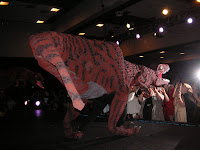

The convention is now held the first weekend of October. For a long time, it was held in July. The heat of a St. Louis summer made some of the costumes torture to wear. Costuming is an important part of a con. The weather in October is chancy at best, but this year was delightfully cool, allowing fen to wear an imposing array of the costumer's art.
![]() Science fiction is a genre with many sub-genres. Some of these, like horror, are found in different parts of the book store. Others like fantasy, space opera, hard science fiction, alternate history, cyberpunk, steampunk and military SF are lumped in with the other parts of science fiction. It mostly depends on the management of the store or chain. But all of these can be taken under the mantle of SF.
Science fiction is a genre with many sub-genres. Some of these, like horror, are found in different parts of the book store. Others like fantasy, space opera, hard science fiction, alternate history, cyberpunk, steampunk and military SF are lumped in with the other parts of science fiction. It mostly depends on the management of the store or chain. But all of these can be taken under the mantle of SF.

Science fiction is not something new. Although Jules Verne is the father of modern SF, it goes back at least to the 17th century. During that time, Savien Cyrano de Bergerac (yes, the guy the play was written about) published his "Comic Story of the Countries of the Moon and Sun." If you're not familiar with the play, read it. There are some of the most romantic scenes ever written therein. The films based on the play are very well done and fairly faithful to the original by Rostand. However, there have been claims that science fiction goes all the way back to biblical times. When I was growing up, I read several articles that claimed that the "great wheel" seen by Ezekiel.
Fandom (another SF word) consists of a huge variety of people. There are science fiction clubs and authors all over the Americas, Europe and the Far East. In fact, each year, a world science fiction convention is held. More abut that in the parties section. While many fen are scientists and engineers, a multitude of other folk love the genre or part of it. There are teenagers, literature students, artists, clerks, accountants and policemen that I have met at cons. Fandom is also one of the most accepting, tolerant populations I have met. Almost any foible is acceptable at a con.
alt=""id="BLOGGER_PHOTO_ID_5259777841943807890" />

The gentleman in this photo, by the way is running his computer from a solar cell.
The most common question I hear about science fiction conventions (cons is so much easier, but a little repetitive) is "What do you do there?" The answer to that is quite a bit. During the day, there are panel discussions ranging from weapons of the medieval warrior to surgery in space. Experts in writing and publishing talk about both writing and getting what you write published. Artists will talk about how they got into SF art or how they draw imaginary creatures. Astronomers can give lectures on how to make up realistic imaginary worlds or biologists might talk about what sort of aliens might exist. I even managed to give a few panels about my life with big cats.


In the evening, there is more programming, usually there is a continuous science fiction film show and the parties. Parties are an integral part of the con experience. Reasons for hosting parties can vary from the desire to get together with friends and others to a bid for a world science fiction convention (worldcon) location. You see, worldcons are held in a different city every year. There have been a number of repeat visits, to Los Angeles and to Denver, for examples. But the con itself moves each year. Attendees of the worldcon two years before vote on the location and the winner hosts the worldcon two years hence. Believe me, two years are the minimum required to organize a successful worldcon. It is usually the biggest SF con held in the year, hosting memberships from 3,000 to 10,000 in recent years. The parties are to convince fen that a particular locale is ideal for a worldcon. Since some delightful people love to throw parties, there are also fake worldcon bid parties for places like the moon or Mars.
The parties usually serve food typical of their areas and some serve beverages native to their areas. Especially notable among these was the successful Scotland bid party. Glasgow won hands down that year.
Last, but not least, many people ask about the "Trekkies". They are with us, along with fans of Dr. Who and other TV series. But Star Trek was the seminal science fiction television show and brought the medium to the attention of more people than anything until Harry Potter (there are Harry Potter fans too.)


Try Googling "Science Fiction Convention" and attend one in your area.
Before getting to the convention, I must pause to review some nomenclature. SF fans (there is a minor disagreement about whether it should be SF [ess eff] or Sci Fi) have a few words of their own. Prime examples are con for convention and fen as the plural of fan. Non SF readers are called mundanes.


The convention is now held the first weekend of October. For a long time, it was held in July. The heat of a St. Louis summer made some of the costumes torture to wear. Costuming is an important part of a con. The weather in October is chancy at best, but this year was delightfully cool, allowing fen to wear an imposing array of the costumer's art.
 Science fiction is a genre with many sub-genres. Some of these, like horror, are found in different parts of the book store. Others like fantasy, space opera, hard science fiction, alternate history, cyberpunk, steampunk and military SF are lumped in with the other parts of science fiction. It mostly depends on the management of the store or chain. But all of these can be taken under the mantle of SF.

Science fiction is not something new. Although Jules Verne is the father of modern SF, it goes back at least to the 17th century. During that time, Savien Cyrano de Bergerac (yes, the guy the play was written about) published his "Comic Story of the Countries of the Moon and Sun." If you're not familiar with the play, read it. There are some of the most romantic scenes ever written therein. The films based on the play are very well done and fairly faithful to the original by Rostand. However, there have been claims that science fiction goes all the way back to biblical times. When I was growing up, I read several articles that claimed that the "great wheel" seen by Ezekiel.
Fandom (another SF word) consists of a huge variety of people. There are science fiction clubs and authors all over the Americas, Europe and the Far East. In fact, each year, a world science fiction convention is held. More abut that in the parties section. While many fen are scientists and engineers, a multitude of other folk love the genre or part of it. There are teenagers, literature students, artists, clerks, accountants and policemen that I have met at cons. Fandom is also one of the most accepting, tolerant populations I have met. Almost any foible is acceptable at a con.
alt=""id="BLOGGER_PHOTO_ID_5259777841943807890" />

The gentleman in this photo, by the way is running his computer from a solar cell.
The most common question I hear about science fiction conventions (cons is so much easier, but a little repetitive) is "What do you do there?" The answer to that is quite a bit. During the day, there are panel discussions ranging from weapons of the medieval warrior to surgery in space. Experts in writing and publishing talk about both writing and getting what you write published. Artists will talk about how they got into SF art or how they draw imaginary creatures. Astronomers can give lectures on how to make up realistic imaginary worlds or biologists might talk about what sort of aliens might exist. I even managed to give a few panels about my life with big cats.


In the evening, there is more programming, usually there is a continuous science fiction film show and the parties. Parties are an integral part of the con experience. Reasons for hosting parties can vary from the desire to get together with friends and others to a bid for a world science fiction convention (worldcon) location. You see, worldcons are held in a different city every year. There have been a number of repeat visits, to Los Angeles and to Denver, for examples. But the con itself moves each year. Attendees of the worldcon two years before vote on the location and the winner hosts the worldcon two years hence. Believe me, two years are the minimum required to organize a successful worldcon. It is usually the biggest SF con held in the year, hosting memberships from 3,000 to 10,000 in recent years. The parties are to convince fen that a particular locale is ideal for a worldcon. Since some delightful people love to throw parties, there are also fake worldcon bid parties for places like the moon or Mars.
The parties usually serve food typical of their areas and some serve beverages native to their areas. Especially notable among these was the successful Scotland bid party. Glasgow won hands down that year.
Last, but not least, many people ask about the "Trekkies". They are with us, along with fans of Dr. Who and other TV series. But Star Trek was the seminal science fiction television show and brought the medium to the attention of more people than anything until Harry Potter (there are Harry Potter fans too.)


Try Googling "Science Fiction Convention" and attend one in your area.
Arkansas State Fair part III
I see, by reviewing my older blogs on this subject, that I managed to duplicate some pictures. I'll try to get some more in this time, since my last attempt was truncated by schedule and slow upload times.


That's all for that. My next posting shall be about the science fiction convention sponsored by the St. Louis Science Fiction Society. The convention is named Archon and that will be part of the title.


That's all for that. My next posting shall be about the science fiction convention sponsored by the St. Louis Science Fiction Society. The convention is named Archon and that will be part of the title.
Subscribe to:
Posts (Atom)
